
Every year around March, and again around September, HR inboxes across Bangalore start filling up with the same question: “What are we doing for the team offsite this time?” Someone in the group forwards a resort link. Someone else suggests bowling, again. And somewhere in there, a manager quietly hopes this year’s outing doesn’t end up feeling like last year’s — forgotten by the following Monday.
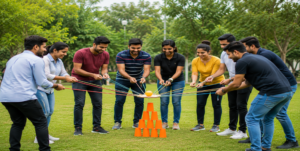
If you’ve searched for team building activities in Bangalore, team outing companies in Bangalore, or corporate offsite planning in Bangalore, you’ve probably noticed how crowded this space is. Dozens of vendors, all promising “engagement” and “bonding,” most of them running the same fixed package regardless of who’s booking it. So let’s slow down and actually talk through what works, what doesn’t, and why Bangalore specifically needs its own playbook.
Why Bangalore Teams Need This More Than Most Cities
Bangalore runs at a different pace. It’s India’s tech and startup hub, which means young teams, fast hiring, faster attrition, and a lot of people who’ve never actually met half their colleagues in person — thanks to hybrid work becoming the norm rather than the exception. People are connected on Slack all day and somehow still feel like strangers.
That’s the exact gap a good team building activity is supposed to close. Not with trust falls or forced enthusiasm, but with structured experiences that get people problem-solving side by side, seeing each other outside their job titles for a few hours. Get this right, and it shows up later in how fast a new hire settles in, how smoothly two teams merge after a reorg, and how honestly people speak up in meetings. Get it wrong — an unplanned picnic with no structure to it — and you’ve just given everyone a paid day off. Pleasant, maybe. Pointless, mostly.
Corporate Outbound in Bangalore: Taking the Team Off-Site, Literally
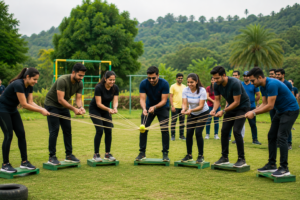 A corporate outbound in Bangalore moves the team physically away from the workplace, usually somewhere the hierarchy loosens up a little just by virtue of not being in a conference room. It has a genuine advantage here — within two to three hours you’ve got Nandi Hills, Ramanagara, Kanakapura, Coorg’s outer edges, and a whole cluster of resorts built specifically with corporate groups in mind.
The outbounds that actually land tend to combine three things: activities tied to a real objective (better cross-team communication, surfacing quiet leaders, breaking silos), enough unstructured downtime that people don’t feel herded through a schedule, and logistics so smooth that whoever organised it isn’t the one stressed out on the day.
That last part matters more than people expect. The trip itself is just the container. What happens inside it — the actual activities and how they’re facilitated — is where the value comes from.
Choosing Between Team Outing Companies in Bangalore
 Search for team outing companies in Bangalore and you’ll get pages of results. Most split into two camps: pure entertainment vendors (games, a DJ, a resort tie-up) and firms that actually design around a learning outcome. The difference isn’t always obvious from a website.
A few questions worth asking before signing anyone:
Does the vendor customize the day around your team’s actual dynamics, or is it the same fixed itinerary for every client that walks in? Is there a facilitator who debriefs the activity afterward — connecting the game back to something real about how your team works — or does it just end and everyone drifts off confused about the point of it? Can they handle the whole thing end-to-end (venue, transport, food, equipment) so your internal team isn’t fielding fifteen vendor calls the week before? And have they actually run programs at your team’s size — a 25-person startup offsite and a 400-person tech-floor event need completely different planning.
A vendor who answers all four with specifics is worth shortlisting. One who only talks about “energy” and “fun” without mentioning what happens after the event is a decent sign to keep looking.
Employee Engagement Activities in Bangalore: Beyond the One Big Trip a Year
Team building doesn’t need to be a single annual event. A lot of companies are shifting toward shorter, more frequent employee engagement activities in Bangalore — half-day workshops, CSR-linked sessions like build-and-donate drives, leadership-specific interventions for managers who need it more than anyone else on the team.
This matters even more for hybrid teams. A short in-office session once a quarter, paired with a bigger annual offsite, tends to keep culture alive in a way that one big event never quite manages on its own. The one-big-trip model has a shelf life — by month three, most people have forgotten it happened.
Corporate Offsite Planning in Bangalore: The Part Nobody Warns You About
Corporate Offsite planning in Bangalore always sounds simpler on paper than it turns out to be. Coordinating transport for 80 people, tracking dietary restrictions, having a weather backup, sourcing activity equipment, getting three rounds of budget sign-off — the planning itself is often more exhausting than the event.
Bangalore adds its own complications. Traffic, for one — a resort listed as “60 km away” can easily be a two-hour drive depending on when you leave. Monsoon season, roughly June through September, means outdoor plans need a real indoor backup, not just a vague Plan B. And startups in particular often need venue flexibility because the team that fits in a 40-person space today might be 70 people by the next offsite.
Handing this to a company that’s already solved these problems dozens of times tends to save far more stress than trying to build the logistics from scratch internally, year after year.
Outdoor Team Building in Bangalore: Making Use of the Geography
For most of the year, there’s weather and its ring of hills and countryside make it genuinely well suited to outdoor team building in Bangalore. A few formats that consistently work well: obstacle-based challenges that force a group to problem-solve under mild physical pressure, treasure hunts across a resort or campus that mix strategy with movement, and trust-and-communication exercises — blindfolded navigation, rope-based challenges, that kind of thing.
Outdoor activities tend to stick in people’s memory longer than indoor icebreakers, mostly because you can’t zone out through a rope course the way you can during a conference-room game. Physical presence forces mental presence.
Adventure Outbound Programs in Bangalore: When the Standard Offsite Gets Stale
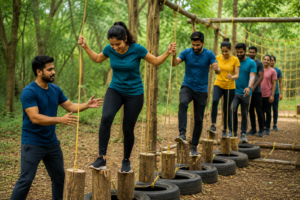 For teams that have already been through a few rounds of the usual offsite circuit, adventure outbound programs in Bangalore raise the stakes — rappelling, zip-lining, night trekking, survival-style team tasks near places like Ramanagar or Kanakapur. These tend to work especially well for leadership groups or high-performing teams who find standard icebreakers a little flat by now.
Safety and facilitation are non-negotiable here. Certified instructors, proper equipment checks, and — just as important — a facilitator trained to pull the actual leadership lessons out of the adventure activity afterward. Adrenaline without a debrief is just a thrill ride. Adrenaline with the right debrief is where the real learning happens.
So, Which One Do You Actually Need?
Honestly, it depends on where your team is right now. A newly formed or post-merger team probably needs indoor, low-stakes activities that build basic rapport before anything more physical. A team that’s been together a while and is looking a bit flat might need an outdoor or adventure push instead. A leadership team trying to align on strategy might need less “activity” altogether and more space — a well-run offsite with room for honest conversation.
The pattern that separates a forgettable outing from one people are still talking about six months later usually comes down to three things: a clear objective before anyone books a venue, a vendor who customise instead of templating, and logistics handled well enough that nobody on your team even has to think about them on the day.
About RMG Mileage
RMG Mileage has been designing and running corporate team building programs for over 30 years, working across Bangalore, Delhi NCR, and pan-India. The team has run programs for organisation across IT, BFSI, pharma, FMCG, manufacturing, startups, and PSUs — everything from a half-day indoor session for 30 people to a multi-day adventure outbound for 500.
What sets the approach apart is less about the games themselves and more about what happens around them — certified facilitators trained in organisational behaviour rather than just event hosting, a debrief built into every session as standard rather than a paid add-on, and end-to-end handling of logistics so HR teams aren’t juggling a dozen vendor calls in the week before an event. RMG Mileage also runs virtual and hybrid formats for distributed teams, along with adventure programs near Nandi Hills, Ramanagar, and other spots within a few hours of Bangalore.
If you’re comparing options and want an honest read on whether a particular format actually fits your team — rather than a sales pitch for whatever’s easiest to sell — that’s the kind of conversation worth having before booking anything.
Frequently Asked Questions
What’s the ideal group size for a corporate team building activity in Bangalore? There isn’t really a fixed number — activities can be designed for a 15-person team or a 400-person tech floor. What changes is the format. Smaller groups often do well with indoor, discussion-heavy sessions, while larger groups usually need outdoor or resort-based formats with multiple facilitators running parallel activities.
How far in advance should we start planning a corporate offsite? For anything involving 50+ people, 6-8 weeks is a reasonable minimum, mainly because resort and transport availability in popular spots near Bangalore (Nandi Hills, Coorg, Ramanagar) fills up quickly during peak season. Smaller, single-day events can sometimes be planned in 2-3 weeks if the vendor already has strong local logistics in place.
Are outdoor team building activities safe during Bangalore’s monsoon season? Outdoor activities are usually fine outside the heavier monsoon months (roughly June to September). During that window, most experienced vendors build in an indoor backup plan for every outdoor activity, so the event doesn’t get cancelled or rescheduled last minute.
Can team building programs work for hybrid or remote teams? Yes — this is increasingly common in Bangalore given how many teams have people spread across cities or working remotely. Hybrid formats usually combine an in-person component for local team members with a virtual or metaverse-style session that remote employees join, so nobody’s left out of the experience.
How is a “team outing” different from a “team building activity”? A team outing is broader — it can be a resort trip, a celebration, or a relaxed group getaway without a specific behaviour objective. A team building activity is more structured and usually tied to a goal with a facilitator guiding the process and debriefing it afterward. Many good offsites blend both — some structured sessions alongside genuine downtime.